
What Happens When Everything Becomes Easy to Build?
The bottleneck isn't building anymore...

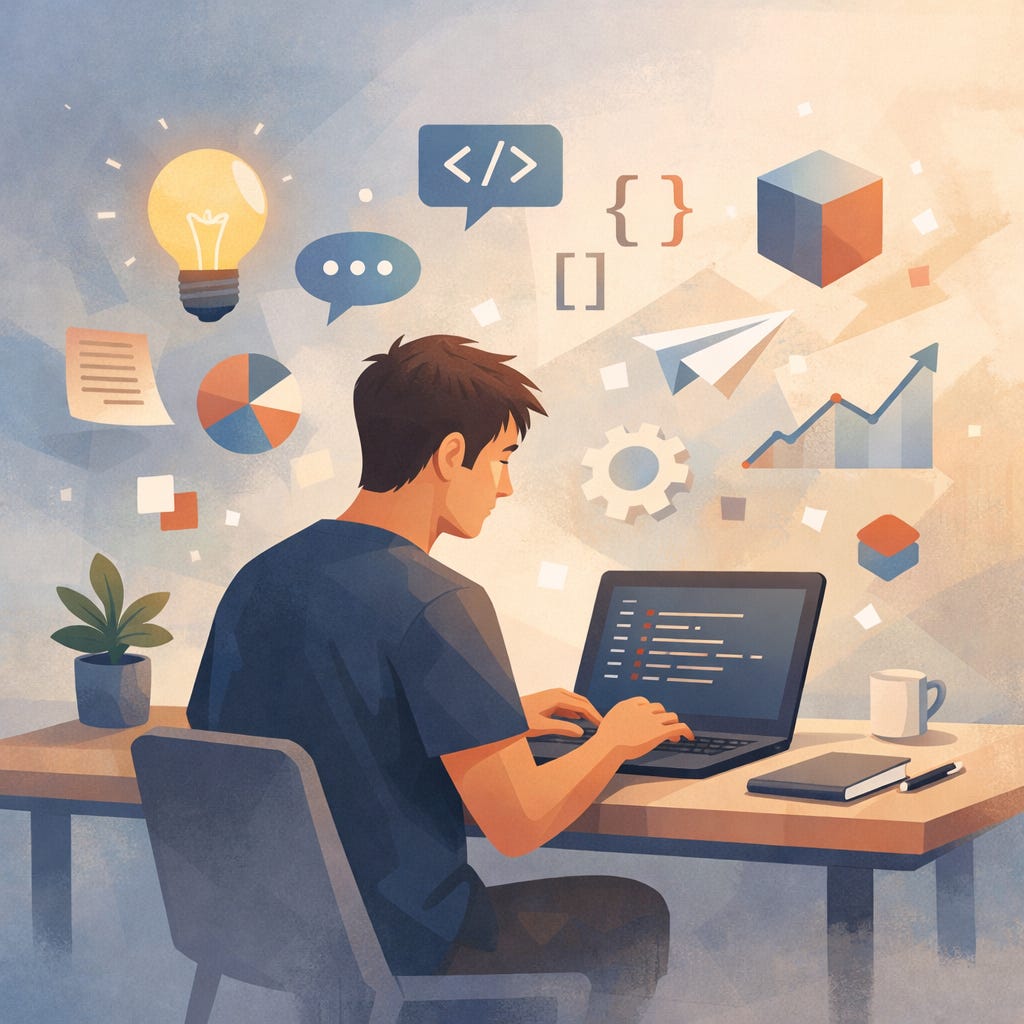
For most of the history of technology, the bottleneck was obvious: building things was hard. You needed engineers, capital, and time. Starting a software company meant assembling a team of specialized developers, spending months in development, and often raising money before you had a single working product to show for it. The people who could build had enormous leverage over those who couldn’t and that asymmetry shaped everything about how startups worked.
Fortunately for non-technical folks, that world is disappearing fast. Today, you can sit down with a laptop and have a working prototype in hours (not months, not weeks, but hours). AI coding tools, no-code platforms, and natural-language programming are rapidly collapsing the cost of software creation. Gartner predicts that by 2026, 70% of new applications will be built with low-code or no-code tools, and AI already writes a meaningful portion of code at many organizations with that number still climbing. The barriers that once protected software development are coming down, and that changes everything downstream from it.
The most interesting thing about this shift isn’t just that the tools are powerful but it’s that they make building accessible to almost anyone. Product managers can generate prototypes. Operators can build internal tools. Non-technical founders can launch products. Students can spin up entire startups over a weekend. I keep coming back to the analogy of writing: two hundred years ago, publishing something required a printing press - capital, infrastructure, gatekeepers. Today, anyone can publish an idea instantly. Software is going through the same transformation, and just like with writing, the question stops being “can you do it?” and starts being “do you have something worth saying?”
Which raises an uncomfortable question: if everyone can build, what actually matters? When building becomes trivial, something else becomes scarce and in my opinion, that something is judgment. The shift isn’t technical, it’s philosophical. The question moves from “can this be built?” to “should this be built?”
For decades, the primary constraint in startups was execution. Could your team actually ship? How fast, how reliably, how cheaply? That constraint is weakening, and in its place a different one is emerging - taste and problem selection. The world doesn’t need more software… It needs the right software, built for the right people, solving problems that are genuinely worth solving. And identifying those problems is much harder than writing code.
This is where things get interesting because deciding what to build requires things AI is still genuinely bad at: understanding messy, human problems or identifying overlooked or underserved markets or having taste about what people actually want. The tools can generate code but they can’t yet generate total insight. That’s still human work and it might actually be becoming more valuable as a result. When the cost of experimentation approaches zero, the winning teams aren’t the ones who build faster. They’re the ones who ask better questions.
Lately, the conversations I'm having with builders have shifted in a subtle but striking way. A year ago, most of them started with some version of "how do I build this?" - a question about tools, architecture, hiring, timelines. Now, more and more of them start with "is this even worth building?" That's a fundamentally different conversation, and I think it reflects something real about where the hard work has moved. The bottleneck used to be implementation. Now it's clarity about the problem, the user, and what actually matters to build in the first place. In a world where everything can be built, taste becomes the moat.
Here’s what I find most interesting about all of this: the best way to develop that judgment might actually be to build more than ever. When it takes hours instead of months to create something, you can run dozens of experiments, test ideas rapidly, and explore weird corners of markets you’d never have had the bandwidth to explore before. You can build simply to learn, without needing to justify it as a business yet. And over time, patterns emerge. You start to notice what problems are real versus imagined, what users actually do versus what they say they want, and what markets are genuinely hungry versus merely theoretically interesting. The builder’s advantage isn’t going away, it’s just changing shape.
The biggest breakthroughs of the next decade probably won’t come from people who know how to build. They’ll come from people who know what’s worth building because when the cost of creation drops to near zero, the scarcest resource becomes insight. Ideas matter more than implementation. Curiosity beats credentials. Taste beats technical skill. Everything is becoming easier to build, which means the real frontier is finally coming into focus: figuring out what to build in the first place. That might be the most exciting part of this entire moment and the one most people are still sleeping on.